
Feb 01, 2026 – By Zenx News
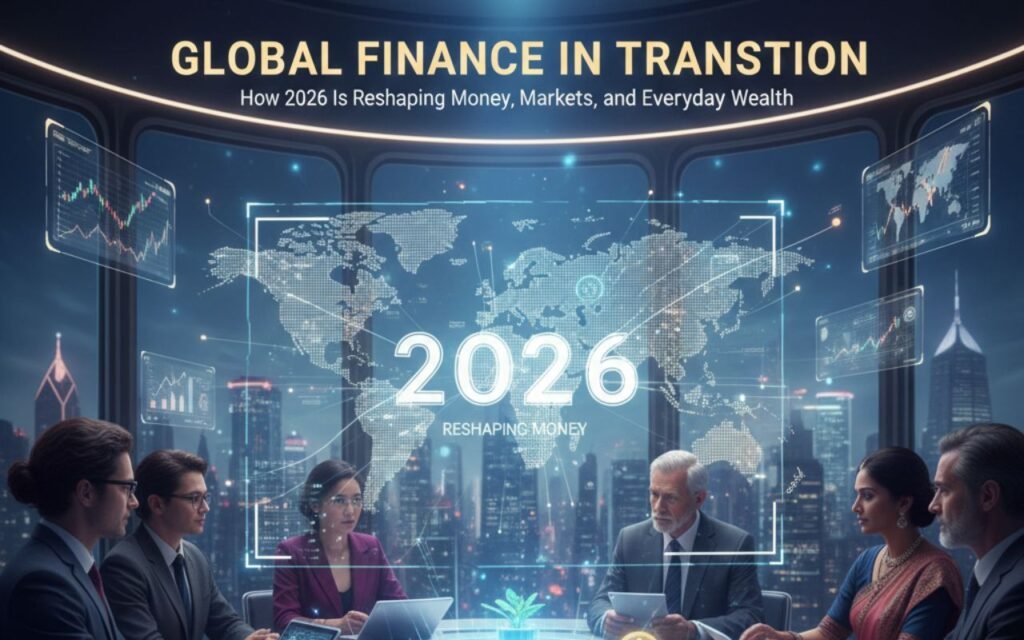
The global financial system is undergoing one of its most significant transitions in decades. As 2026 unfolds, economies across the world are adjusting to a new reality shaped by high interest rates, changing investment behaviour, digital transformation, and shifting geopolitical priorities. What once worked in finance five years ago is no longer guaranteed to succeed today.
From central bank policies to personal wealth management, from global markets to everyday household finances, money is being redefined. Governments, corporations, investors, and ordinary people are all responding to the same question: How do we stay financially secure in an uncertain world?
This moment marks not a financial crisis, but a financial reset.
The Global Economic Mood in 2026
Unlike the shock-driven downturns of the past, the current financial environment is driven by prolonged adjustment. Inflation has cooled in many regions but remains structurally higher than pre-pandemic levels. Interest rates, while stabilising, are no longer near zero. Borrowing has become more expensive, forcing both governments and consumers to rethink spending.
Major economies such as the United States, Europe, the UK, and parts of Asia are navigating slower but more disciplined growth. Emerging markets are seeing mixed outcomes — some benefiting from manufacturing shifts and exports, while others struggle with debt servicing and currency pressure.
The world is not collapsing financially — but it is learning to live differently with money.
Central Banks: Power Players of the New Financial Era
Central banks continue to play a defining role in shaping global finance. Over the past two years, aggressive rate hikes were used to control inflation. In 2026, the focus has shifted from tightening to maintaining balance.
Rather than cutting rates aggressively, policymakers are prioritising:
- Price stability
- Financial system resilience
- Long-term economic sustainability
This cautious approach signals a permanent shift away from ultra-easy money. For investors and businesses, this means capital is no longer cheap — but it is more predictable.
Global Markets: Volatility With Opportunity
Financial markets in 2026 are marked by frequent fluctuations, but not chaos. Stock markets rise and fall based on earnings, interest rate expectations, and geopolitical signals rather than pure speculation.
Equities
Investors are favouring:
- Companies with strong cash flow
- Essential services (healthcare, utilities, infrastructure)
- Technology firms with real profitability rather than hype
Short-term trading has declined, while long-term investing is regaining respect.
Bonds
After years of low returns, bonds have re-entered the spotlight. Higher yields have made government and corporate bonds attractive again, particularly for conservative investors seeking stability.
Commodities
Gold continues to act as a hedge against uncertainty, while energy and industrial metals remain sensitive to global supply chains and geopolitical developments.
Digital Finance: Growth With Regulation
Digital finance has matured significantly. Cryptocurrencies, once driven by speculation, are now facing stricter oversight across major economies. While this has reduced extreme volatility, it has also increased credibility.
Key trends shaping digital finance in 2026 include:
- Regulated crypto exchanges
- Institutional involvement in blockchain infrastructure
- Stablecoins used for cross-border payments
- Central Bank Digital Currency (CBDC) pilot programs
Rather than replacing traditional finance, digital assets are integrating into it.
Banking and Lending: A New Discipline
Banks globally have adopted a more cautious approach to lending. Personal loans, mortgages, and business credit now involve stricter risk assessments. This has slowed borrowing — but improved overall financial stability.
Consumers are adapting by:
- Reducing debt exposure
- Preferring fixed-rate loans
- Saving more aggressively
For banks, the focus has shifted from volume to quality lending.
Personal Finance: Smarter, Not Richer
One of the most noticeable changes in 2026 is how individuals manage money. Easy wealth through speculation has given way to financial discipline.
Households are:
- Tracking expenses more closely
- Diversifying income sources
- Prioritising emergency savings
- Investing with longer time horizons
Financial literacy has become a survival skill, not a luxury.
The Rise of Alternative Income and Side Hustles
Traditional employment alone is no longer seen as sufficient for long-term financial security. Across the world, professionals are developing additional income streams.
Popular options include:
- Freelancing and consulting
- Digital products and online services
- Investment income
- Skill-based remote work
This shift reflects a deeper change: people are no longer relying on a single institution for financial stability.
Corporate Finance: Efficiency Over Expansion
Corporations in 2026 are focusing less on aggressive expansion and more on operational efficiency. Cost control, debt management, and productivity improvements are central to business strategies.
Shareholders are rewarding:
- Sustainable profits
- Ethical governance
- Transparent financial reporting
Growth still matters — but reckless growth is penalised.
Global Debt: A Silent Pressure Point
Government debt remains a concern, particularly for highly leveraged economies. Rising interest costs have made debt servicing more expensive, limiting fiscal flexibility.
As a result:
- Governments are cutting non-essential spending
- Tax systems are being reviewed
- Public-private partnerships are increasing
Debt is no longer ignored — it is being actively managed.
Emerging Markets: Diverging Paths
Emerging economies show mixed financial outcomes in 2026. Countries with strong exports, manufacturing capacity, and stable governance are attracting global capital. Others face inflation, currency depreciation, and capital outflows.
For global investors, selectivity is key. Blanket exposure to emerging markets has been replaced by targeted investment strategies.
Finance and Technology: AI Enters the System
Artificial intelligence is now embedded in financial decision-making. Banks use AI for risk assessment, fraud detection, and customer service. Investment firms rely on data models to analyse trends and manage portfolios.
While AI increases efficiency, regulators are monitoring its use closely to prevent systemic risks.
Sustainable Finance: No Longer Optional
Environmental, social, and governance (ESG) finance has evolved from branding to accountability. Investors now demand measurable impact rather than promises.
Green bonds, sustainable funds, and climate-linked investments continue to grow, especially among institutional investors and younger demographics.
What This Means for the Average Person
For everyday individuals, the global financial shift translates into a few clear lessons:
- Debt is expensive — borrow carefully
- Savings matter again — interest rates reward discipline
- Investing requires patience — quick gains are risky
- Skills are financial assets — income stability matters
- Diversification is protection — don’t rely on one source
Money in 2026 is about resilience, not excess.
The Role of Financial Education
As finance becomes more complex, financial education is emerging as a critical pillar of economic stability. Governments, institutions, and digital platforms are investing in financial literacy programs to help citizens navigate modern money systems.
Understanding inflation, interest rates, credit, and investment is no longer optional — it is essential.
Looking Ahead: The Financial Future Beyond 2026
The financial world is unlikely to return to its old norms. Instead, a new equilibrium is forming — one where growth is slower but more sustainable, where money has a real cost, and where long-term planning matters more than short-term speculation.
Those who adapt — individuals, businesses, and governments alike — will find stability and opportunity. Those who resist change may struggle.
Conclusion: A New Financial Reality
The global finance landscape in 2026 is not defined by crisis, but by correction and maturity. Markets are more cautious, consumers are more aware, and institutions are more disciplined.
For ZenX News readers, this moment represents an opportunity — to understand money better, make smarter decisions, and build financial security in a changing world.
Finance is no longer just about wealth.
It is about control, clarity, and confidence.