
December 22, 2025 – ZenX News Desk
Today’s global scientific community is buzzing with eye-opening discoveries and observations from space and beyond, with several breakthroughs offering fresh insight into the universe and our understanding of natural phenomena.
Rare Cosmic Collisions Observed by Hubble
Astronomers have reported a rare sequence of cosmic events captured by NASA’s Hubble Space Telescope near the star Fomalhaut, about 25 light-years from Earth. In recent observations, scientists detected clouds of dust created by two massive collisions between rocky bodies, each estimated to be at least 60 kilometers wide. These collision remnants, believed to have occurred within a relatively short cosmic timeframe, were previously mistaken for a potential exoplanet but are now understood to be the aftermath of high-energy impacts. Researchers say studying the evolution of these dust clouds helps shed light on planetary formation processes and the dynamics of young solar systems. AP News
Meteor Shower Peaks Over the Holidays
Sky-watchers are being treated to a spectacular natural show as the Ursid meteor shower reaches its peak overnight on December 21–22. During this event, observers in darker skies are expected to see up to ten shooting stars per hour, offering a festive highlight for stargazers and amateur astronomers alike. The Ursids are associated with the debris trail of comet 8P/Tuttle, and this year’s peak coincides with long winter nights in the Northern Hemisphere, making the display especially visible. Space
Spacecraft JUICE Spots Activity from Interstellar Object
The European Space Agency’s JUICE Mission, designed to explore Jupiter’s icy moons, has turned its instruments toward the interstellar object 3I/ATLAS, capturing new data and activity signatures. This marks one more step in understanding objects originating outside our solar system, which can offer clues about the composition and dynamics of distant cosmic matter. Such observations contribute to long-term studies of how interstellar visitors interact with solar radiation and magnetic fields as they traverse our region of space. Universe Today
James Webb Telescope Adds to Space Surprises
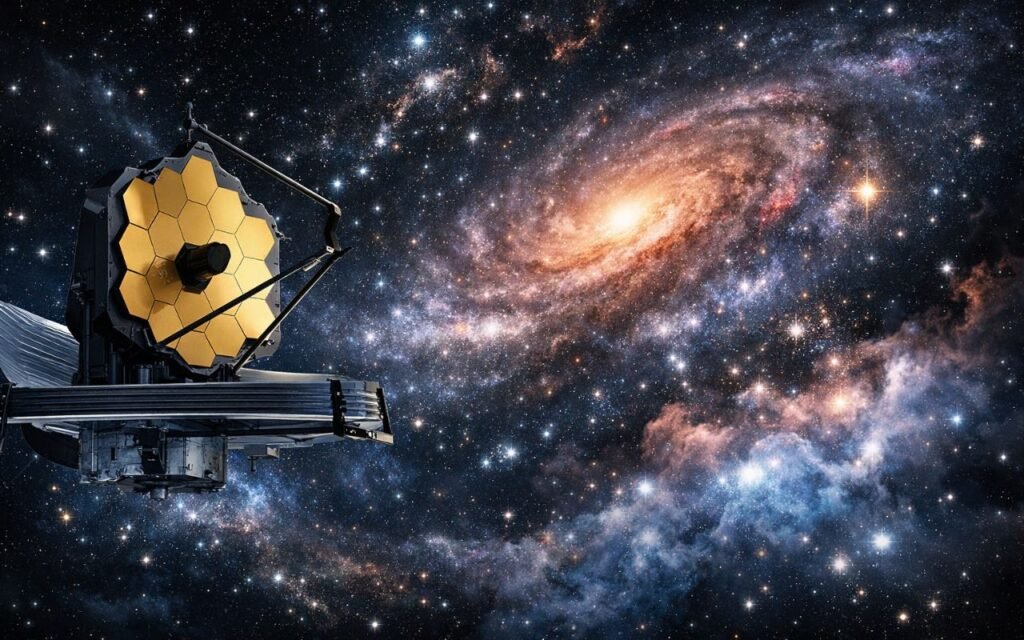
In addition to the cosmic collisions near Fomalhaut, the James Webb Space Telescope continues to provide stunning images and fresh discoveries. Recent data has revealed unique galactic structures and detailed views of interstellar environments that highlight complex behaviors in star formation and galactic interactions, expanding our view of how the universe shapes itself over billions of years. Live Science
Challenging Assumptions about Saturn’s Moon Titan
A new astronomical study suggests that Saturn’s largest moon, Titan, may not possess a subsurface global ocean as previously believed. Instead, researchers now think that thick layers of slushy ice and pockets of liquid water under Titan’s icy crust could explain observational data better than a single vast ocean. This finding reshapes ongoing theories about where life-friendly environments might exist in the solar system and guides future missions like NASA’s Dragonfly toward better target objectives. AP News
Why These Developments Matter
These science updates highlight the breadth of modern research — from observing cosmic mechanics billions of kilometers away to tracking meteor showers visible with the naked eye. Together, they reflect an era of rapid scientific exploration, enabled by powerful observatories, advanced instrumentation, and international cooperation in space science.
While each development comes from a different corner of research — astrophysics, observational astronomy, and planetary science — collectively they deepen humanity’s understanding of the universe and the place of Earth within it.